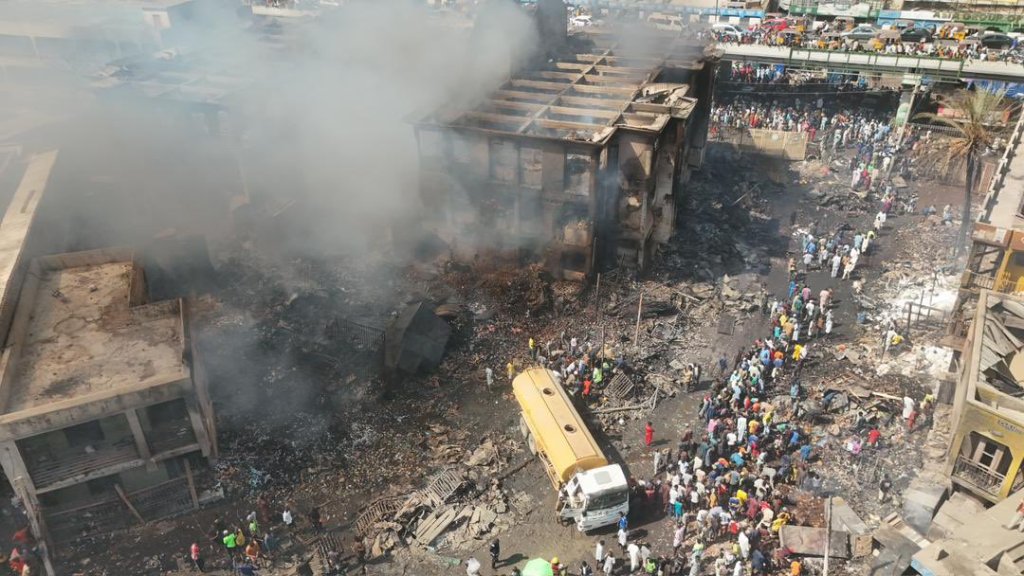
The recent infernos at Kano’s Singer Market are more than a tragic commercial disaster—they are a policy failure unfolding in real time. Within a month, two devastating fires have swept through the market, destroying over 1,000 shops and inflicting losses estimated in the hundreds of billions of naira. For a market that serves as a wholesale hub for processed food commodities across northern Nigeria and neighbouring countries, the implications extend far beyond Kano’s commercial ecosystem.
Preliminary reports from market authorities and the Federal Fire Service suggest that solar panels installed on one of the buildings may have triggered the blaze. Yet, focusing solely on the immediate ignition source risks missing the deeper structural failures that made such destruction inevitable. While faulty solar installations may have sparked the fire, they did not determine its scale. The real question is why the market lacked the resilience to contain the inferno.
The destruction exposes long-standing deficiencies in market planning and regulation: inadequate fire hydrants, congested access routes that impede emergency response, chaotic building layouts, poor electrical wiring, and the absence of clearly designated parking and safety corridors. These are not incidental oversights—they are governance issues rooted in weak enforcement of urban development regulations and infrastructure standards.
For a moment, the government is not solely to blame for this culture of negligence, especially when people’s fortunes are at stake. Traders’ unions should lead the charge in this regard, with the government playing a supporting and regulatory role. One cannot reasonably blame local authorities alone when, in a community where burglars target multiple houses, a particular household is consistently the easiest to break into. Such vulnerability may stem from negligence in setting up basic security measures or from an unnecessarily ostentatious lifestyle that invites unwanted attention.
This is not to suggest that the responsibility for providing security does not primarily rest with the government. Rather, it is to argue that citizens are also expected to be vigilant and proactive, particularly when vigilance means protecting their lives, families, and livelihoods. In such circumstances, one can never be too cautious.
Recommendations for Traders and Market Associations
1. Prioritize Safety in Shop Design and Equipment: Traders must adopt basic fire safety measures—fire extinguishers, smoke detectors, and safe storage of flammable goods. Collective procurement of safety equipment can reduce costs.
2. Demand Professional Electrical and Solar Installations: Cutting costs on electrical installations often leads to catastrophic losses. Traders should patronize certified electricians and solar installers and insist on compliance certificates.
3. Organize Collective Safety Protocols: Market associations should develop internal fire response protocols, including designated emergency exits, fire wardens, and training drills for traders and apprentices.
4. Hire Professional Security Firms for Market Area Surveillance: Professional security companies can be hired through a partnership between market unions and local authorities. Traders should contribute small levies to fund 24/7 CCTV monitoring and controlled entry points. The government should license and supervise these firms and link them with the police for quick response.
Recommendations for the Kano State Government
1. Enforce a Comprehensive Structural Market Plan: The state government must move beyond reactive firefighting to proactive planning. Markets should operate under a government-approved physical development framework that dictates building layouts, spacing, road access, and safety infrastructure. Informal expansions and unauthorized structural modifications should be systematically regularized or dismantled.
2. Invest in Fire Safety Infrastructure: Functional fire hydrants, strategically located fire stations, and rapid-response units must be integrated into major commercial clusters. Markets like Singer should be treated as critical economic infrastructure, deserving the same safety standards as industrial zones and the state government house. After all, where are all the taxes they pay?
3. Regulate Renewable Energy Installations: Solar energy is not inherently dangerous, but unregulated installations are. The state should establish certification requirements for solar installers, enforce compliance with electrical safety standards, and conduct periodic inspections in commercial hubs.
4. Improve Electrical Grid Safety: Poor wiring from transformers to buildings remains a persistent risk. Mandatory electrical audits, standardized wiring codes, and penalties for non-compliance are essential to reducing fire hazards.
5. Strengthen Urban Market Governance: Market management committees should be integrated into the state’s urban planning and emergency management frameworks, ensuring coordination between traders, regulators, and emergency services.
A Preventable Tragedy
The Singer Market fires should not be remembered as unfortunate accidents but as preventable governance failures. Markets are the arteries of Nigeria’s informal and formal economies, and their safety is a public policy imperative.
Without decisive reforms, Singer Market will not be the last commercial hub to go up in flames. The question is not whether another market will burn—but whether Nigeria will finally treat market infrastructure as a matter of national economic security.
 Abdul's Analysis
Leave a comment