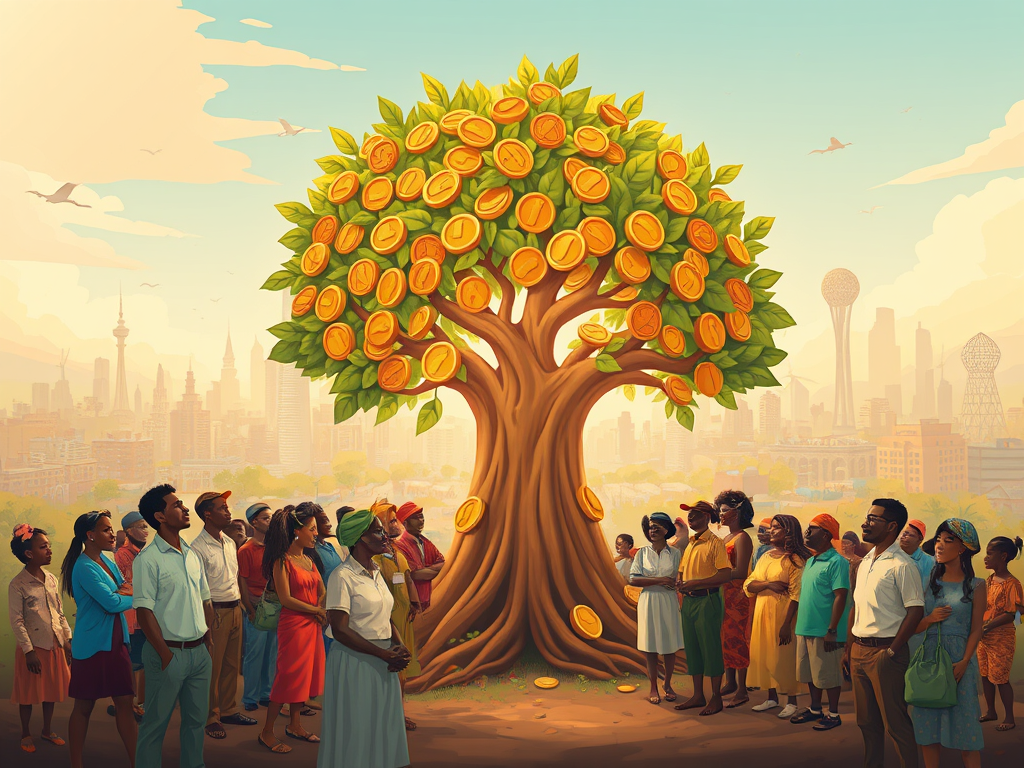
Tax Them to Prosperity
Nigeria has enacted a new tax law that became effective in January 2026. Though controversial in the public eye, the political leadership remains adamant that the new tax formula will favour the poor and drive overall national development by ensuring that the country musters sufficient fiscal capacity to meet Nigeria’s ever-growing development needs.
The new tax reform is expected to increase Nigeria’s non-oil revenue sources and improve the country’s tax-to-GDP ratio, which remains relatively low compared to its peer economies. By doing so, the Tinubu administration argues, Nigeria will be better positioned to fund social services and critical infrastructure.
For business owners and corporate entities, the reform promises greater transparency in tax recording and reporting, easing processes and improving compliance. For instance, all Value Added Tax (VAT)–registered businesses are now mandated to subscribe to the Electronic Fiscal System (EFS) to record real-time transactions for reporting purposes. This measure is intended to reduce tax fraud.
Banks and other financial service providers are also required to report large transactions and submit quarterly reports to tax authorities on customers with cumulative inflows or outflows exceeding ₦25 million for individuals and ₦100 million for corporations. This suggests that Nigerians and business entities are now more accountable to the state in their financial dealings. It signals stronger law and order, more meticulous state administration, and an increased stake for citizens in the nation’s economic well-being. Greater responsibility should come with greater privileges—at least, that is how it ought to be. But are Nigerian taxpayers prepared to assume that responsibility and ensure that their entitlements are delivered?
To Nigerians criticising the tax reforms, the focus should not be solely on how much they will pay in taxes—whether voluntarily or involuntarily—because that decision has already been made by the legislature and the executive. A deeper examination of whether this decision reflects popular consent is a subject for another article. This piece instead seeks to shed light on the trajectory of the nation’s tax regulations, what the average citizen should expect and demand from political leadership, and why it is time to embrace responsible citizenship in its truest sense. It would be extremely costly to remain uninformed about how public funds are spent. This discussion should also serve as a wake-up call to the Economic and Financial Crimes Commission (EFCC) regarding how corruption cases are prosecuted and how stolen assets are recovered for the state.
In practical terms, Nigerians enjoy little to no public amenities across most aspects of daily life. It is common for any Nigerian who wishes to have electricity for more than eight hours a day to generate power independently, either through a solar inverter or a petrol-powered generator. Only God knows how many billions of naira have been plundered over the past 30 years under the guise of transforming the nation’s electricity sector. The situation is no better when it comes to federal highways. A glaring example is the Abuja–Kaduna highway, which has been under so-called construction for nearly a decade, yet not even half of it has been completed. A journey that should take one hour and thirty minutes now takes an average of three hours. This significantly undermines the movement of people and goods, as well as the nation’s overall ease of doing business. God alone knows how many lives have been lost due to the poor condition of this road over the past decade.
Nigeria’s roads are not dilapidated because the state lacks the money to fix them. They are in ruins because corruption has been allowed to thrive within the public and civil service sectors. Take the Abuja–Kaduna–Zaria–Kano Highway as a painful example. In 2018, the contract was awarded to Julius Berger at a cost of ₦155.7 billion, with a promise of completion in just three years. Eight years later, the road remains largely the same—dangerous, broken, and unforgiving—while the projected cost shockingly ballooned at one point to ₦1.5 trillion. The Tinubu administration finally revoked the contract and reassigned it to another company, now estimated to cost ₦740 billion to complete.
This is not a story of insufficient funds; it is a story of wasted resources, broken promises, and a system that operates without fear of consequence. Every extra naira demanded from taxpayers under the banner of reform risks disappearing into the same black hole unless the culture of secrecy, impunity, and poor oversight is dismantled. Taxing citizens harder will not fix Nigeria’s problems if public spending remains shielded from transparency and accountability.
More revenue alone will not build roads, save lives, or restore trust. Only an engaged and courageous citizenry can do that—people willing to ask hard questions, demand clear answers, and insist on value for every kobo spent. The state has already made it clear that it will enforce tax compliance with the full weight of the law. The pressing question now is whether citizens will rise to enforce accountability with the same determination, or continue to pay endlessly for promises that never materialise.
Citizens should no longer look on in awe—or silence—when public office holders overspend on unnecessary extravagance. It is common in Nigeria to see the president travel with convoys of nearly a hundred SUVs, many of which carry only two or three security personnel. The same pattern is repeated by governors and other public officials across the country. Yet, we rarely hear any serious public debate about how politicians intend to cut such excessive spending, even as the nation searches for ways to maximise revenue generation and reduce public waste. Are we expected to accept this continued display of luxury by the political class while the average citizen is increasingly taxed into despair?
As the tax reforms take effect, the state must also reform how public contracts are awarded. Contract payments should be made more transparent, and the recovery of stolen public funds by the EFCC and similar bodies, such as the Independent Corrupt Practices and Other Related Offences Commission (ICPC), must be conducted with greater openness. The reallocation of recovered funds should be subject to public scrutiny and criticism.
It is clear that among the people most affected by this tax reform are salary earners. Thus, should they not consider forming a national union—with state and local government chapters—distinct from the existing Nigeria Labour Congress—to scrutinize budgets, liaise with state and national legislatures, and engage public officeholders to ensure that approved budgets are effectively translated into tangible projects?
If taxes are collected and used responsibly, they can become a powerful tool for national progress—one that lifts the country and taxes its people into shared prosperity. But if citizens continue to shoulder the burden of taxation without demanding transparency or performing their civic due diligence, the outcome will be far darker. In that case, they will not be taxed to prosperity, but taxed into despair—and history shows that despair, when ignored long enough, often ends in revolt.

 Abdul's Analysis
Leave a comment